
StackPicker vs ChatGPT for Tech Stack Advice: Is There a Better Alternative?
How StackPicker compares to ChatGPT for tech stack decisions: where chat shines, where it breaks, and when a dedicated stack picker wins.
Leonard
Leonard is Director and Builder at Caydev.

Ask any founder in 2026 where they started their last tool decision and you will get the same answer more often than not. ChatGPT. Type the question, scan the answer, paste a few names into Google, sign up. The path of least resistance now starts in a chat window, and it ends with twelve free trials in your inbox six weeks later.
That works fine for the first stack decision. It works less well for the fifth. By then the cost of a wrong pick has started compounding, and the limits of asking a chatbot "what stack should I use" are showing up in real money. That is what sends people looking for a StackPicker alternative to the chat window: a tool built for the part of the decision that ChatGPT was never designed to handle.
This is a fair comparison of where ChatGPT helps with tech stack questions, where it falls apart, and what a dedicated AI stack picker does differently. No spin. ChatGPT is a remarkable research tool. It is also the wrong shape for a job that needs cost visibility, integration awareness, and a stack you can actually share with a co-founder.
Where ChatGPT Earns Its Place in Tech Stack Research
ChatGPT is genuinely useful for the early, exploratory phase of a tech stack decision, and the honest version of this article has to start there.
The model has read enormous amounts of documentation, comparison blogs, Reddit threads, and Hacker News debates. If you ask it "what are the leading options for transactional email in 2026," you will get a credible list inside ten seconds. The conversational format lets you follow up, narrow scope, and ask "what about for a team with no SRE." That kind of back-and-forth is faster than reading five blog posts written by people getting paid by one of the vendors.
ChatGPT is also free in its baseline form, available everywhere, and infinitely patient. For ideation, for understanding categories you have never touched before, it is hard to beat. The trouble starts when "research" becomes "decision."
Where ChatGPT Breaks Down for Real Stack Decisions
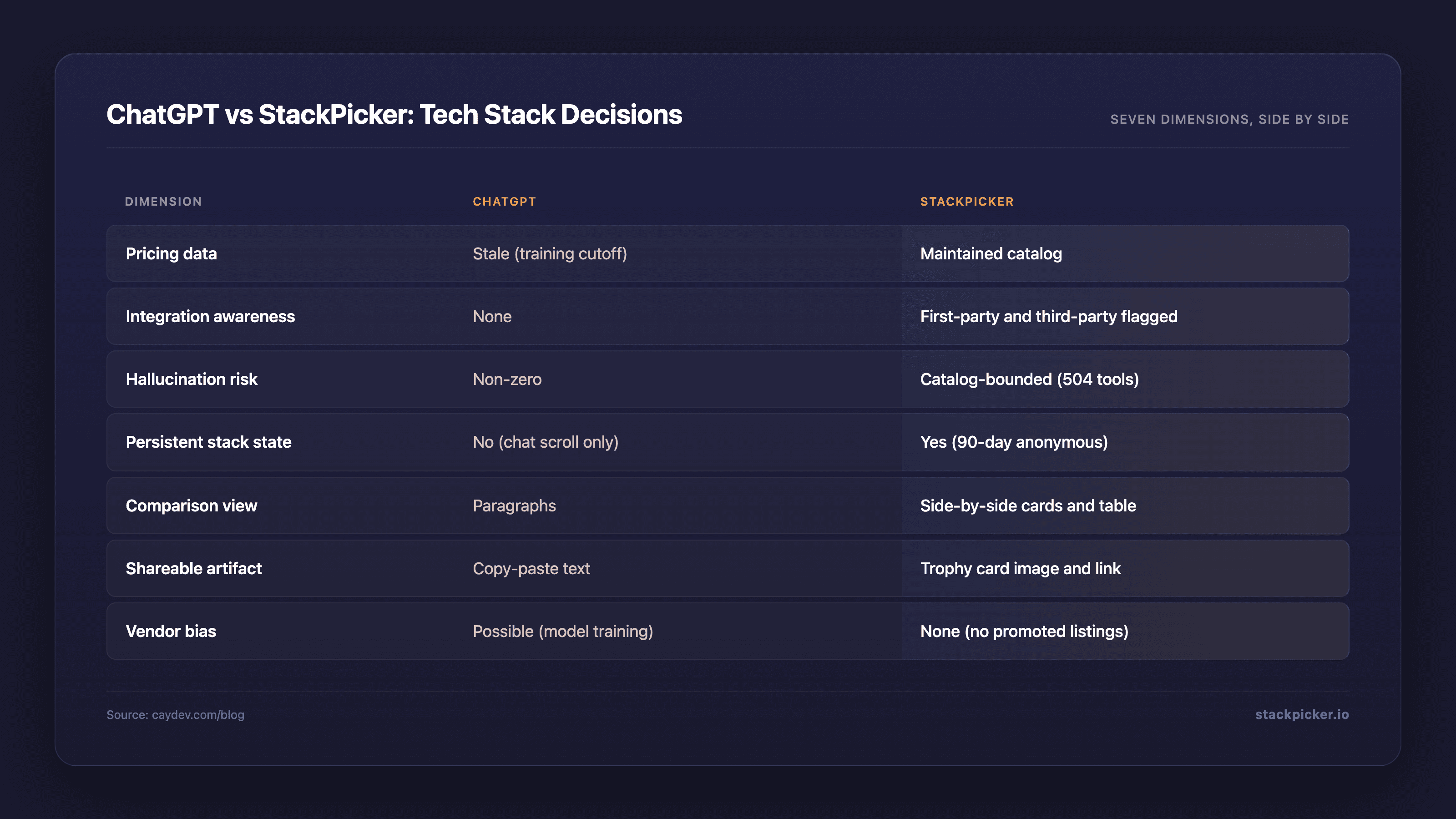
Five concrete failure modes show up when founders try to use ChatGPT as the deciding tool rather than the warming-up tool.
1. The Pricing Data Is Stale
ChatGPT's training data has a cutoff date. SaaS pricing pages do not. The "starter tier" that the model quotes you as $29 a month might be $59 today, or it might have been replaced by a usage-based model that meters differently. Ask ChatGPT about Vercel's hobby plan, Supabase's free tier limits, or Linear's seat pricing and you will get answers that were correct on some Tuesday in 2024.
2. Integrations Are a Blind Spot
Picking a stack is not picking five tools. It is picking five tools that need to talk to each other. ChatGPT can name two tools, but it cannot reliably tell you whether the one you picked for billing has a native connection to the one you picked for CRM, or whether you need a Zapier seat to glue them together. It does not know which integrations are first-party, which are community-maintained, and which were deprecated last quarter.
3. Hallucinated Tools Still Happen
Ask ChatGPT for a niche category and you will sometimes get a confident answer that includes a product that does not exist, a product that was sunset two years ago, or a product whose features the model has confused with a competitor. In our experience the rate is lower than it used to be. It is still high enough to matter when you are about to enter a credit card.
4. There Is No Stack State
Every ChatGPT conversation is a fresh document. If you spend twenty minutes building up "okay so we have Stripe, Vercel, Supabase, Resend, and PostHog," that picture lives in the chat scroll and nowhere else. You cannot share it as an object. You cannot come back to it cleanly in two weeks. You cannot send it to your co-founder for review. The artifact does not exist.
5. There Is No Comparison View
When ChatGPT lists three options for a category, it gives you a paragraph on each. What you actually want, ninety percent of the time, is a side-by-side. Price, integrations, free tier, where it shines, where it falls short. The chat format flatters discussion and hides comparison.
What StackPicker Does Differently
StackPicker is a free AI stack picker built by Caydev. It is not trying to replace ChatGPT as a research tool. It is trying to replace the spreadsheet, the note doc, and the six open browser tabs that founders use when they have decided ChatGPT has given them enough and now they need to commit.
Three things make it work differently.
One Screen Instead of Six Tabs
The catalog is 500+ tools across 24 categories, all viewable on one screen. G2 was built for procurement departments running multi-month software RFPs. StackPicker was built for a founder who has twenty minutes between meetings to lock in a tooling decision.
See What the Stack Costs Before You Buy It
You add tools to a stack and see the total monthly cost build up as you go. You see which categories you have covered and which you have not. You see when you have added two tools that do the same job. Most founders learn what their stack costs only after the renewal emails start arriving, and by then a thousand small decisions have already been made.
No Pay-to-Play, No Upsells
The AI Stack Advisor's recommendations aren't pay-to-play: nothing in the catalog is a sponsored placement and rankings aren't sold. It will tell you that you do not need the tool you just asked about, which is something a sponsored comparison site cannot afford to do. It also knows what is already in your in-progress stack when it makes a suggestion. StackPicker was built by Caydev, a bootstrapped studio out of the Cayman Islands, which matters mostly because there are no investor relationships shaping what gets recommended.
There is no account, no email gate, no sign-up. Stacks persist anonymously for 90 days. You can share one with a link or export a trophy card image to send to a co-founder.
When to Use ChatGPT and When to Use a Stack Picker
Honest answer. Both, in sequence.
Use ChatGPT for the first half of the decision. The half where you are still learning the category, still narrowing the field, still asking the dumb questions you would not want logged in a public artifact. This is what conversational AI is good for.
Use StackPicker for the second half. The half where you have a candidate list, you need to see what it costs together, you need to check that the pieces fit, and you need to walk away with something you can share.
The two tools answer different questions. "What exists in this category" is a ChatGPT question. "Does this stack actually work for my situation, and what does it cost together" is a StackPicker question.
A Worked Example: A Two-Person SaaS Startup
We ran the exact prompt "what stack should a two-person SaaS startup use" through both tools.
ChatGPT returned a thoughtful eight-paragraph answer recommending Next.js, Supabase, Vercel, Stripe, Resend, and PostHog. No prices. No integration check. No total. The advice was correct in the abstract. It also could have been written by any blog post in the last two years.
StackPicker returned a stack with the same six tools (mostly) plus three you would forget to include, like a transactional email tool sized for the volume and a two-factor auth option that integrates with the auth layer. Total monthly cost calculated live in the builder as we configured it. Your configuration will vary, but the number was visible the whole way, not discovered after twelve sign-ups. Integration compatibility was flagged tool-by-tool, separating native connections from ones that would need a middleware layer. Trophy card generated as a shareable image. The whole interaction took about three minutes.
The Short Version
If you are still figuring out what you need, talk to ChatGPT. If you are ready to lock something in, build the stack somewhere that shows you the bill before the bill shows up.
StackPicker is free at stackpicker.io. No account, no email gate, 500+ tools, and recommendations that aren't pay-to-play. Build the stack, share it, and pick something else if it does not hold up. The point is to have the conversation with yourself before you have it with your credit card.
If you want deeper context on how the AI Stack Advisor works, see stackpicker. And if you are at the point of managing tools you already pay for instead of picking new ones, that is what savemysaas does.